


By Juli A. Metzger—
MUNCIE, IN—Area nonprofits pump $1 billion in annual revenue into the local economy and represent one quarter of the county workforce, according to new data from the Nonprofit Support Network.
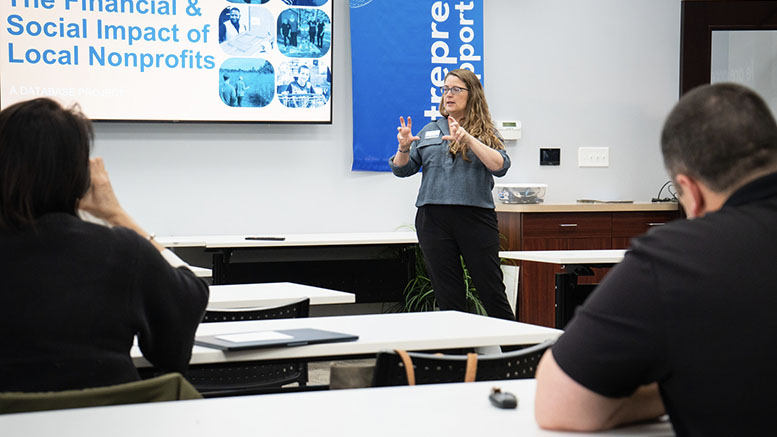
Jena Ashby, NSN Relationship and Resource Director, highlighted the changes in a presentation Thursday, at the Innovation Connector.
“What’s clear is the impact of our nonprofits is substantial and meaningful,” Ashby said. “We’re more than social programs. We’re an economic engine.”
Research found 1,279 nonprofits on record in Delaware County. Filtering out churches and inactive or defunct nonprofits, 400 remain. Of that, 68 are employers. Collectively, they account for 25 percent of the employment base – more than 12,000 jobs of the approximately 45,000 jobs in Delaware County – outpacing all other sectors in employment in the county.
“This is a diversified talent pool that keeps our local middle class strong,” Ashby said.
And the money follows.
Ball State University and IU Health Ball Memorial account for nearly $917 million of the more than $1 billion in annual revenues generated by area nonprofits. The sector handles a financial flow equivalent to over one-fifth of local GDP.
“That $1 billion is a massive influx of outside capital, federal grants, state contracts, and private foundations, that is being imported into our zip codes and spent at our local businesses,” Ashby said.
“We have to start looking at the nonprofit sector through an economic development lens,” Ashby said. “If the nonprofit sector disappeared tomorrow, it would create a significant economic and social disruption.”
The two largest employers are Ball State University and IU Ball Memorial Hospital, employing 5,000 collectively. But factor those out, and the remaining 66 nonprofits, generate just over $80 million in annual revenue, research found. Fifteen nonprofits—primarily in health care, human services, and community support— employ more than 100 people and collectively account for just over 12,000 jobs. They demonstrate the breadth of mission‑driven institutions providing stable employment across multiple professional fields.
The nonprofit sector’s influence is not limited to large institutions. Equally important is the wide network of nonprofits employing 10 to 99 people, with work spanning food security, early childhood education, arts & culture, workforce training, and community philanthropy. These 25 mid-sized nonprofits provide invaluable services and stimulate the economy in Delaware County.
The micro-staffed nonprofits, employing fewer than 10, often have an outsized impact on the community. Despite their small size, these organizations tend to be deeply embedded in local networks and closely connected to the people and issues they address. Many rely heavily on volunteers, partnerships, and community support. As a result, they frequently fill critical service gaps and contribute meaningfully to the social fabric of their communities.
In addition to the employment base, nonprofits deploy almost 13,000 volunteers annually. Second Harvest Food Bank and Muncie Mission Ministries top the list with 4,535 and 1,950 volunteers, respectively. Volunteers are donating their time to solve community problems that, if left unaddressed, would eventually become costs for the city, the county, and local businesses.
“We’re among the most generous communities in the state,” Ashby said. “And what we support matters well beyond the programs and social impact of our organizations. It is this collective impact that moves mountains.”
Juli Metzger is a former educator, newspaper editor and publisher.
The post Don’t Take Them For Granted: Area Nonprofits Pump $1 Billion Into Local Economy appeared first on Muncie Journal.

