


By Steven Rogers, Vice President of External Affairs, AT&T Indiana—
INDIANA—On March 10, 1876, Alexander Graham Bell made the first successful phone call in his Boston, Massachusetts laboratory. Bell’s assistant Thomas Watson heard the first sentence ever transmitted: “Mr. Watson, come here; I want you!”
Those words forever changed the way people connect, marking a new age of communication that continues to evolve 150 years later.
AT&T recently announced a $250 billion commitment over the next five years to support the future of connectivity in America. Expanding fiber, 5G, upgrading security and more will lead Indiana’s communications into the modern era.
Fiber is the foundation for the future, light years ahead of traditional copper landlines. It’s faster, more reliable, and more energy efficient. Families and businesses alike depend on these new, more robust networks.
In Indiana, we’ve invested $1.9 billion in our infrastructure from 2021 to 2025. Now, AT&T Fiber is available to 710,000 customer locations in more than 90 communities in the state.
Modernizing communications is key to Indiana’s future, and it must be done thoughtfully and deliberately to prepare Indiana for what’s next rather than continuing to rely on technology of the past.
Traditional copper networks were designed for a different era. Consumer preference reflects that reality as less than two percent of eligible customers across our footprint still use legacy voice services delivered over aging copper networks.
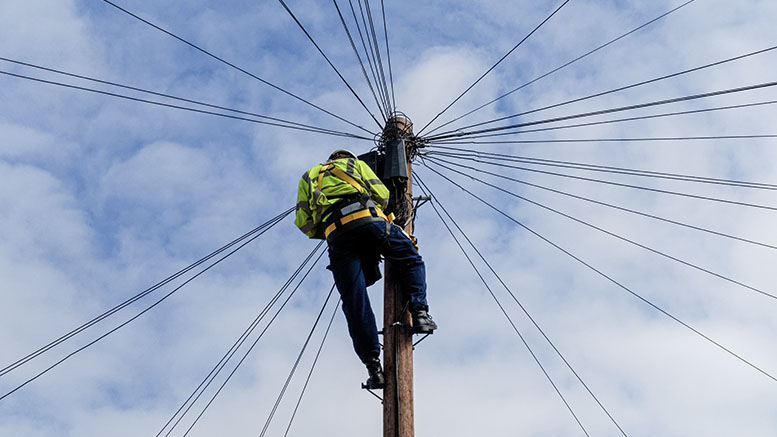
Copper landlines are increasingly more susceptible to weather-related outages and it’s difficult to find parts needed for maintenance and repairs. At the same time, the rising value of copper has made older copper networks a target for theft, causing unexpected disruptions that can even affect one’s ability to call 911.
Also consider that modernizing communications networks can play a major role in reducing energy consumption, a growing issue across Indiana. Because fiber carries light and not electricity like traditional copper lines, it is less expensive to operate, more energy efficient and reliable.
In areas of the country where we’ve transitioned copper lines to fiber, we have seen a 70% reduction in our own energy consumption. In 2024 alone, AT&T reported saving about 340,000 megawatt-hours of electricity by transitioning copper lines to fiber, as cited in a February 2026 report by the International Center for Law & Economics.
As such, AT&T plans to retire our copper landlines in most of our service areas by the end of 2029. This process has been decades in the making and thanks to informed policies at the state and federal level – including approval and backing from the FCC – we are finalizing the transition away from copper to fully modern networks here in Indiana.
While we are investing in expanding and enhancing our fiber and our 5G wireless networks, we are also investing in product development and innovation to offer reliable and familiar services to customers. These services connect rural and hard-to-reach communities and support the needs of households at every income level.
AT&T Phone – Advanced, for example, works just like a traditional landline but delivers clearer phone calls and enhanced security features wirelessly. It’s often available at a lower monthly cost, and upgrading is simple.
While 98 percent of eligible customers across our footprint have already upgraded, we know there will be questions. We’re providing experts and technicians to discuss the upgrade process and directly assist the transition at no cost. In most cases, customers can keep their phone number, continue to use their existing telephone device and may even save money. Perhaps most importantly, customers will continue to have access to voice service and 911 emergency services.
Connecting to family and friends is just as important in 2026 as it was in 1876. We’re here to help Indiana connect faster, safer and more efficiently today, tomorrow and beyond.
The post Upgrading Copper Networks Is Essential for Indiana’s Future appeared first on Muncie Journal.


